
Passenger Transportation Software: How to Choose
A practical guide for fleet owners choosing passenger transportation software: what dispatch, booking and driver tools actually need to do day to day.
If your company moves people for a living, whether that is a taxi fleet, a car service, school routes, staff shuttles, medical appointments or airport transfers, passenger transportation software is the system that holds three things together: how a trip gets booked, how it gets assigned, and what the driver sees. This guide is for the owner or the operations manager doing the choosing, not for the passenger. It covers what the software has to resolve, what changes from one vertical to another, how the two pricing models behave, and the questions worth asking before you sign anything.
What is passenger transportation software?
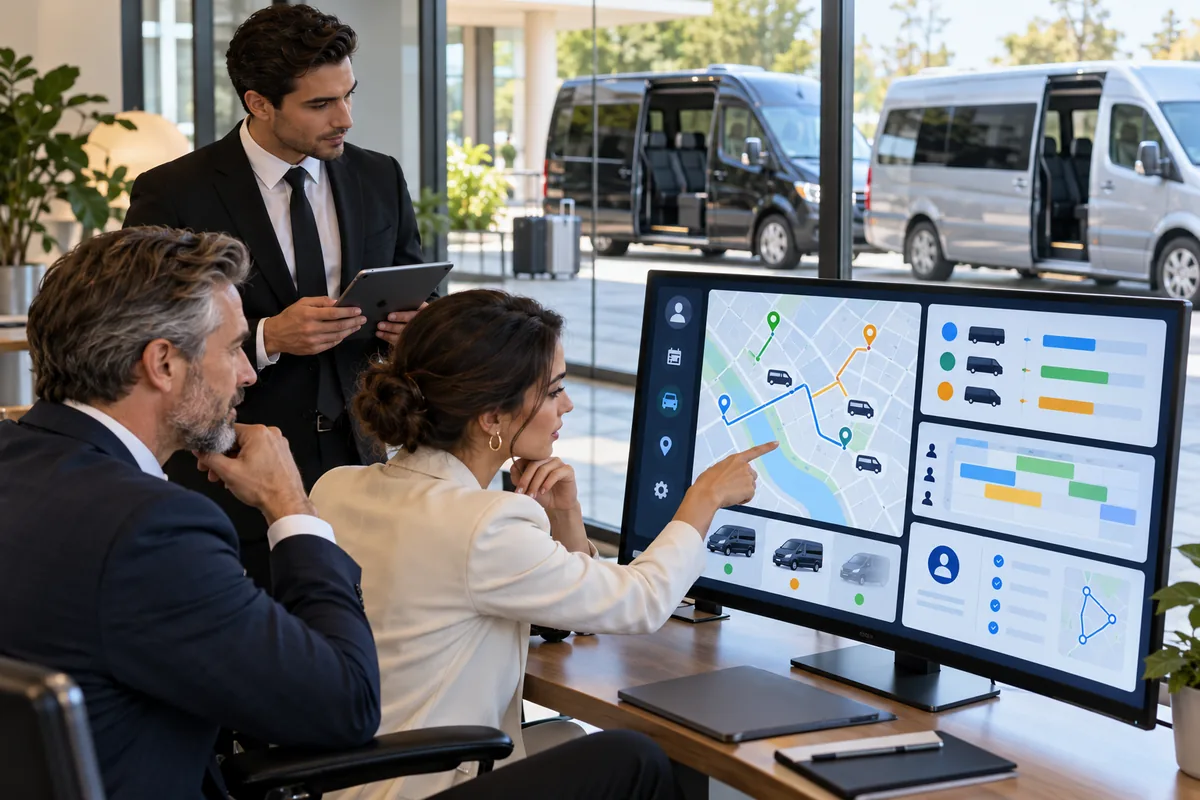
Passenger transportation software is the set of tools a company uses to take a trip request, decide which vehicle serves it, and keep a record of what happened. In practice it is three connected pieces: a booking channel for the customer, a dispatch panel for the office, and an app for the driver. Everything else, from service areas to vehicle categories and reports, is configuration built around those three.
It is worth separating this from fleet telematics. Tracking fuel consumption, maintenance intervals and engine data is a different category of product, usually sold to logistics operations. Passenger transportation software is about the trip and the customer: who asked for it, who is doing it, and whether it happened on time.
Which parts of the operation belong in one system?
The booking, the assignment and the driver's trip should live in the same system. If those three sit in different places, someone in your office spends the day copying information between them, and that person becomes the single point of failure of the whole operation. Everything beyond those three can wait until the basics are stable.
- Trip intake: calls the dispatcher types in, plus bookings the customer makes alone
- Scheduled and recurring trips, not only rides for right now
- Assignment: automatic by distance or availability, offered to several drivers, or done by hand
- The driver app: the offer, the accept, the status changes and the close of the trip
- Customer records: saved addresses and trip history, so a regular never starts from zero
- Service settings: coverage areas, vehicle categories, hours and availability
- Reports: trips per day, per driver, per account and per booking channel
How do you choose passenger transportation software?
Start from the trips you are already losing, not from the feature list. Write down what broke last week, in order, and judge every demo against that list. A platform that solves your three worst situations is worth more than one that does forty things you will never configure.
- Count, for one week, how many bookings arrive by phone and how many by any other channel
- Write down the three trip types that break most often: late night, airport, standing appointments
- Ask who keeps the customer list and the trip history if you stop paying
- Ask what your own staff can change in settings, and what would need development
- Test the dispatch screen with the person who will actually use it, using your busiest hour
- Ask who answers at three in the morning, in what language, and how fast
What changes between taxi, school, staff, medical and tour transport?
The three pieces stay the same; the calendar and the paperwork change. Knowing which pattern your business follows tells you which part of the software you should test hardest in a demo.
- Taxi and car service: mostly on-demand, sharp peaks by hour, and assignment speed decides everything
- School routes: the same trips every weekday for a whole term, with an arrival time that cannot move
- Staff transport: shift-based, booked by a company instead of by the passenger
- Medical appointments: scheduled far ahead, often with a return leg and a long wait
- Airport transfers and tours: booked days ahead, sold through hotels and agencies, with luggage and passenger counts
Operators in regulated segments also carry local permits and documentation requirements. Those are set by your own authority, not by any platform. What software can do is keep the record you will be asked for, which is a different promise from compliance and should be described that way by any vendor you talk to.
How is passenger transportation software priced?
There are two models, and the difference matters more than any single feature: a percentage of every trip, or a fixed monthly fee. A commission grows exactly when you finally have a good month, while a monthly fee is the same number in a slow week and in your best week. Setup work and any custom development are normally quoted separately under either model.
WayCab Plus works on a monthly fee with no percentage per ride and unlimited drivers, with technical support included 24/7. The amount depends on configuration and volume, so it comes out of a conversation rather than a price page. When you compare options, compare what the first twelve months add up to, including setup, instead of comparing headline numbers.
What makes a rollout fail?
Most failed rollouts are not software problems. They are sequencing problems: the company tried to move everything at once, or nobody told the customers anything changed. These are the patterns that come up most often.
- Buying a platform without asking the dispatcher who has to run it
- Moving every trip type at the same time instead of starting with the ones that repeat
- Keeping reservations in the notebook as well, just in case
- Never telling regular customers there is now a second way to book
- Treating custom development as a detail rather than a quoted project with its own timeline
Where WayCab Plus fits
WayCab Plus develops, configures and maintains the rider app, the driver app and the dispatch panel that a transportation company runs under its own brand, so the customer books with your name and the trip history stays in your business. If you want to go deeper into the dispatch side, read Taxi Dispatch Software for Local Cab Companies, and for the direct booking side see Direct Booking App for Taxi Fleets.
Frequently asked questions
Is passenger transportation software the same as fleet management software?
No. Fleet management usually refers to the vehicle: fuel, maintenance, engine data and driver behaviour, and it is often sold to logistics companies. Passenger transportation software is about the trip and the customer: the booking, the assignment, the driver app and the record of what happened. A company that moves people usually needs the second one first.
Can I keep taking bookings by phone?
Yes, and most operators should. The phone does not have to disappear; it just stops being the only door. The dispatcher types the call into the same system where self-service bookings land, so both paths end in one place and your reports finally reflect the whole operation instead of half of it.
Who owns the customer list and the trip history?
Ask that before you sign, because the answer differs sharply between models. In a marketplace the rider belongs to the platform. In a branded, monthly-fee model like the one WayCab Plus configures, the company keeps its own customer relationship and the record of its own operation, which is what lets you see who your best accounts are.
How many vehicles do you need before this makes sense?
It depends less on the number of vehicles than on how many of your trips are planned in advance. If people book you for tomorrow morning, for every weekday or for a standing appointment, a notebook will lose some of those trips no matter how good your memory is. The WayCab Plus model includes unlimited drivers, so growth does not change the structure of the agreement.